
PSITTACINE BEAK AND FEATHER DISEASE
Psittacine beak and feather disease (PBFD) is a highly contagious viral disease of parrots caused by the Psittacine beak and feather disease virus (a circovirus). It primarily affects the cells responsible for feather, beak, and immune system development, leading to progressive feather abnormalities and immunosuppression. PBFD is most commonly seen in young birds, although birds of any age can be affected. The virus is very stable in the environment and can persist for long periods, making it particularly challenging to control in multi-bird households and aviaries.
TRANSMISSION
Transmission occurs through direct contact with infected birds as well as indirect exposure to contaminated feather dust, dander, feces, crop secretions, and environmental surfaces (fomites). The virus is shed in large quantities, especially in feather dust, and can be easily spread on clothing, equipment, and hands. Vertical transmission (from parent to chick) via crop milk or infected eggs is also suspected. Because birds can be infected and shedding the virus without showing clinical signs, apparently healthy carriers play a significant role in disease spread.
All birds are at risk, but PBFD seems to be more of concern in birds of Australian, African, or Asian origin such as cockatoos, lories and lorikeets, African grey parrots, Senegal or Meyer’s parrots, and Ringneck parakeets. Budgerigars and lovebirds seem to have a relatively high rate of infection and caution should be considered if introducing these birds into a house with more susceptible birds such as cockatoos and African grey parrots.
CLINICAL SIGNS IN BIRDS
In general, clinical signs vary depending on the age of the bird and the stage of infection. In acute cases, particularly in young birds, signs may be vague and include lethargy, depression, and sudden death due to severe immunosuppression. More commonly, PBFD presents as a chronic disease in older birds characterized by progressive feather abnormalities such as feather loss, retained feather sheaths, hemorrhage within feathers, and the growth of deformed or clubbed feathers. As the disease progresses, nail and beak lesions may develop, including overgrowth, fractures, and necrosis. Affected birds are also more susceptible to secondary infections due to immune system impairment.
There are also differences in clinical signs depending on the species of bird infected.
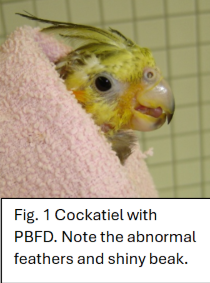
In species that produce heavy powder down, such as African grey parrots, cockatiels, and cockatoos, one of the earliest and most characteristic signs is the loss of the normal powdery coating, resulting in a noticeably glossy or shiny beak and feathers (see Fig.1). These species may also show subtle feather dystrophy before more obvious feather loss develops. African grey parrots are also more likely to show signs of generalized sickness and anemia (low red blood cell count) as the virus targets the bone barrow in this species causing a reduction in blood-forming cells.
In contrast, species that produce little to no powder down, such as macaw and Amazon parrot, are more likely to present with obvious feather abnormalities, including broken, clubbed, or hemorrhagic feathers, as well as progressive feather loss. Beak lesions, such as overgrowth or necrosis, may also be more apparent in these species as the disease advances.
Budgerigars can develop a more acute and severe form of the disease, especially when infected at a young age. In these birds, PBFD may resemble the “French molt” presentation, with rapid loss of major wing and tail feathers, failure to fledge properly, and high mortality in juveniles.
Lovebirds may show variable signs ranging from mild feather changes to severe dystrophy, but in some cases clinical signs can be less pronounced despite infection, contributing to their role as potential carriers. Many lovebirds infected with PBFD virus never show signs of being ill but will shed the virus transiently thus being a source of infection for other birds.
DIAGNOSIS
Diagnosis is typically made using polymerase chain reaction (PCR) testing to detect viral DNA in blood, feather, tissue samples, or swab of the bird’s mouth and vent. In some cases, repeated testing is recommended, especially in birds with suspected early or subclinical infection. Additional supportive diagnostics, such as biopsy of affected feathers or skin, may reveal characteristic changes associated with circovirus infection.
It is recommended that birds testing positive be retested after approximately 90 days, as some individuals may experience transient infection and subsequently clear the virus without developing clinical disease.
TREATMENT OPTIONS
There is no specific antiviral treatment or cure for PBFD. Management focuses on supportive care, including optimal nutrition, minimizing stress, maintaining a clean environment, and treating secondary infections as they arise. Some birds with mild or early infections may stabilize, but many cases progress over time. Due to the contagious nature of the disease, infected birds should be isolated from other birds to reduce transmission risk.
WHAT TO DO AT HOME
Thorough cleaning and disinfection are critical for controlling PBFD. Organic material such as feather dust and droppings must be removed prior to disinfection. Effective disinfectants include those capable of inactivating non-enveloped viruses (e.g., accelerated hydrogen peroxide, bleach at appropriate dilutions). Because the virus is highly resistant, repeated and meticulous cleaning is necessary, along with strict biosecurity practices such as dedicated clothing, hand hygiene, and limiting traffic between bird areas. Items made of wood or other organic material can never be considered clean and should be discarded.
ZOONOTIC CONCERNS
PBFD is not considered a zoonotic disease and does not pose a risk to human health. However, it has significant implications for avian populations, particularly in breeding and multi-bird environments.
IN SUMMARY
In summary, PBFD is a serious, contagious viral disease of parrots that affects feathers, beak, and the immune system. It spreads easily through direct and indirect contact, can be carried by asymptomatic birds, and has no cure. Early detection, strict hygiene, and careful management are essential to reducing its impact and preventing spread. Always practice good quarantine protocols when a new bird is introduced to a flock.
Leticia Materi PhD, DVM
Calgary Avian & Exotic Pet Clinic